Documentation Index

Fetch the complete documentation index at: https://docs.shareofmodel.ai/llms.txt

Use this file to discover all available pages before exploring further.

This guide walks through your workspace, the actions available to you, and how to create your first Brand analysis.

Workspace overview

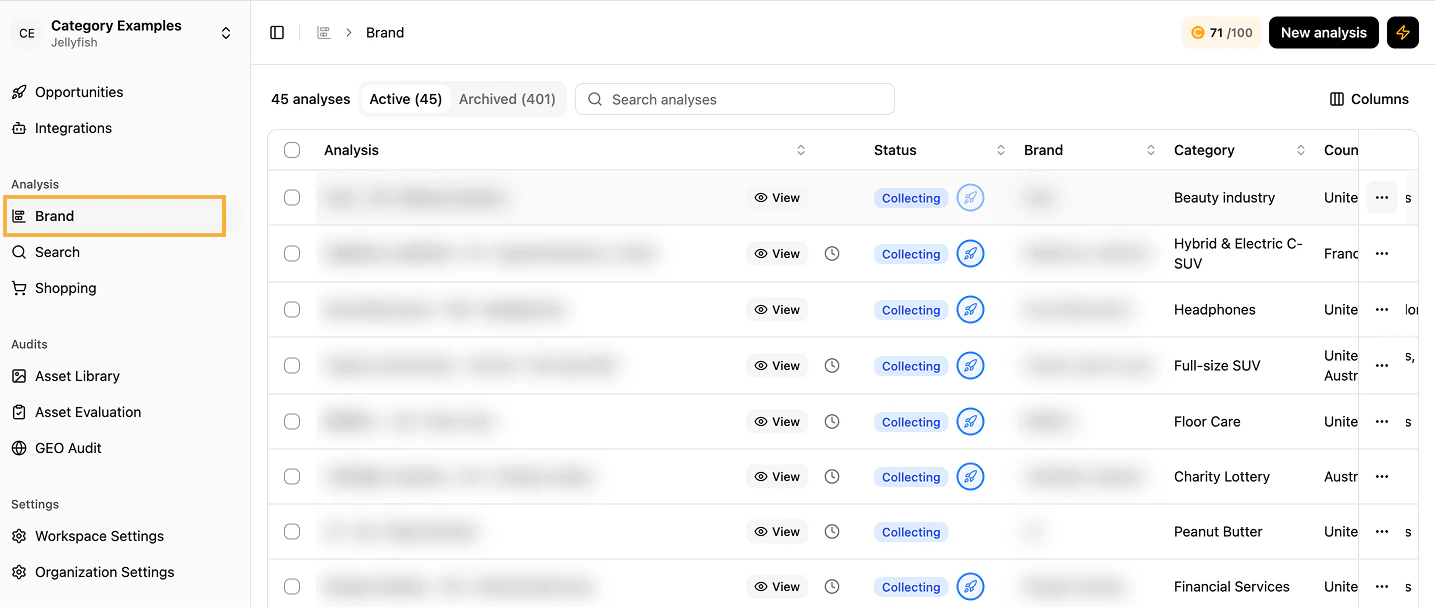
Once you log in, you land on your workspace. If you have multiple workspaces, they appear in alphabetical order. Each workspace contains its own analyses. Switch between workspaces using the dropdown next to the workspace name.
Workspace

Available actions

1

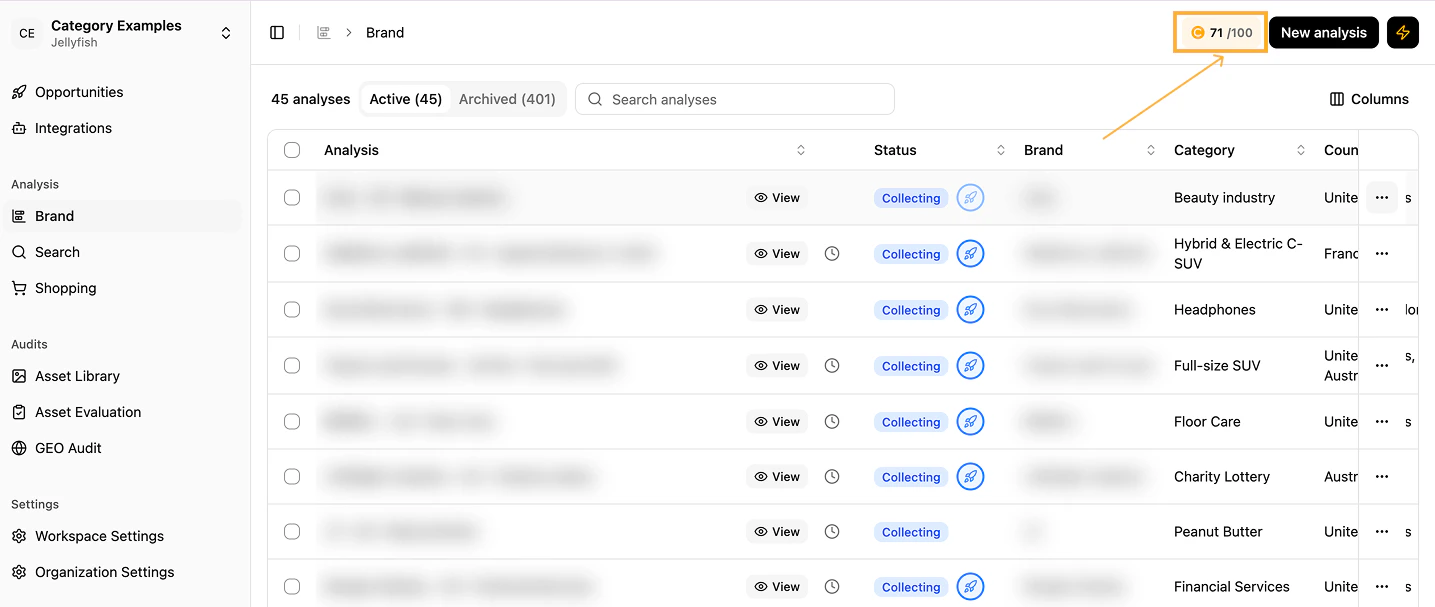
Check credits

Each workspace has a credit balance based on your plan or contract. Credit usage depends on # regions × # personas configured per analysis. Need more quota? Contact your Customer Success Manager.
Credits
See the credit system for the full breakdown.
2

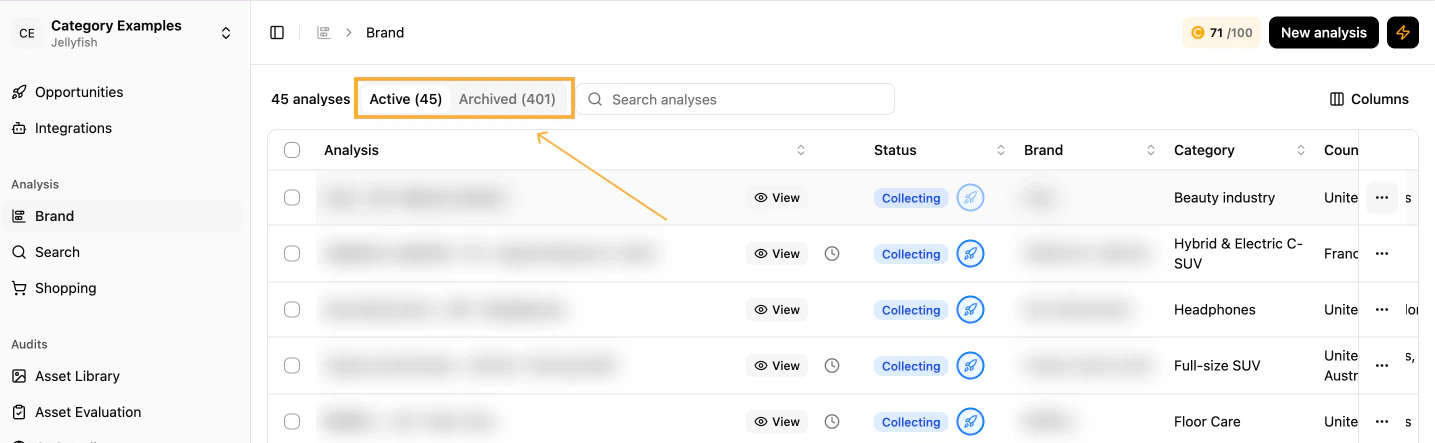
Filter active vs archived

Toggle between active and archived analyses. Archived analyses can be restored if you have available quota.
The period during which an analysis was archived contains no data — data is not backfilled.
Active or archived filter
3

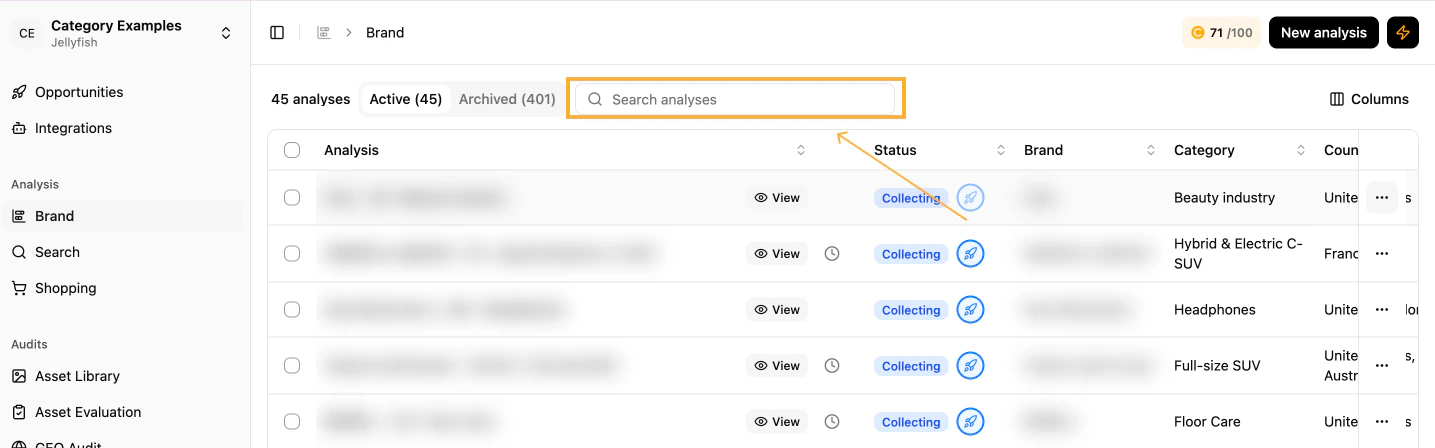
Search analyses

Find a specific analysis quickly via the search bar.
Search
4

Open analysis dashboards

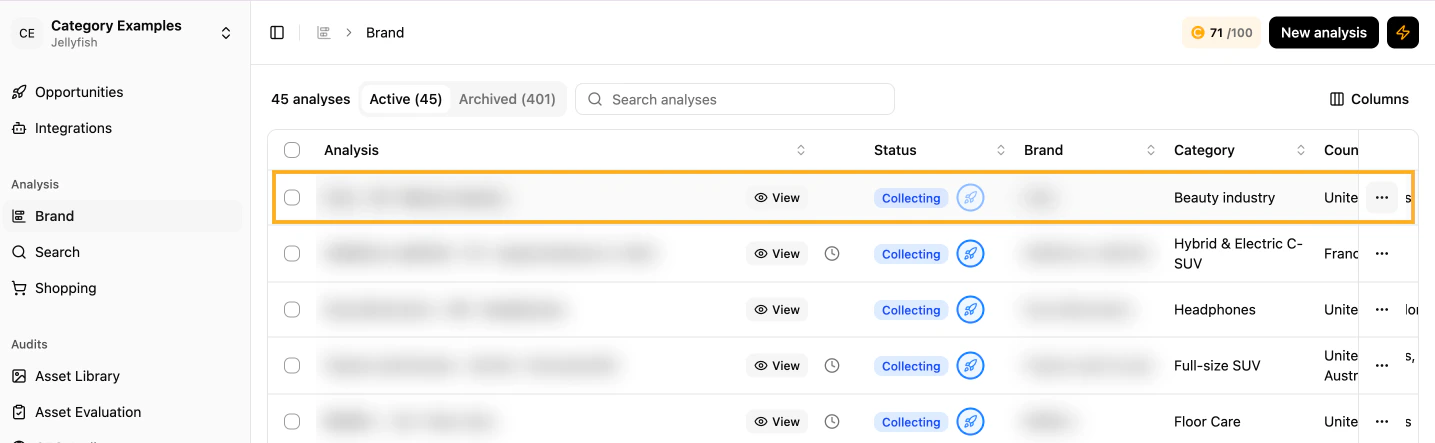
Click anywhere on an analysis row to open its dashboards.
Open analysis
5

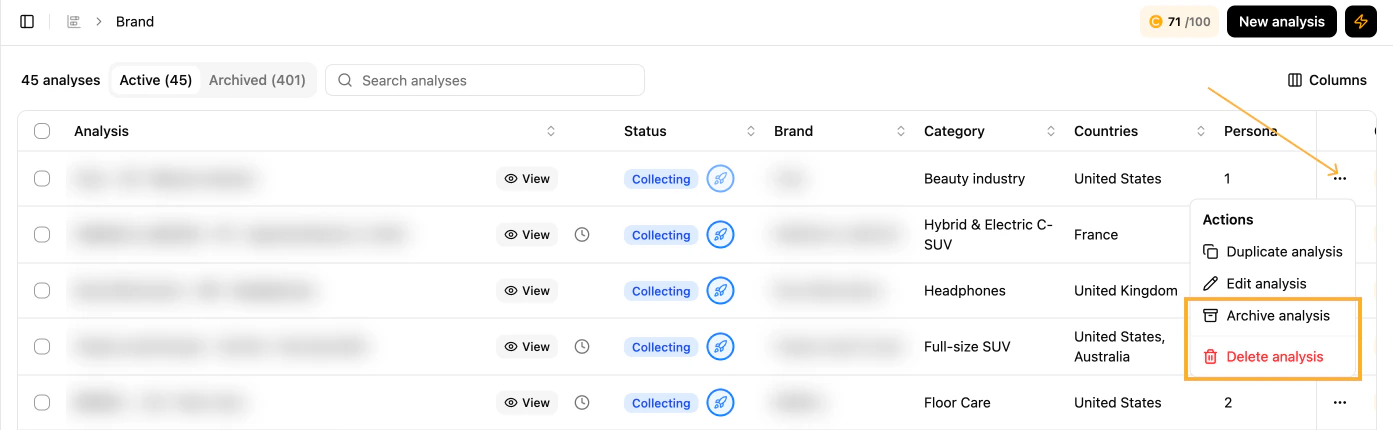
Archive or delete

Each analysis can be archived for later or deleted permanently. From Edit Analysis Duration you can also update or remove the auto-archiving deadline.
Archive or delete
6

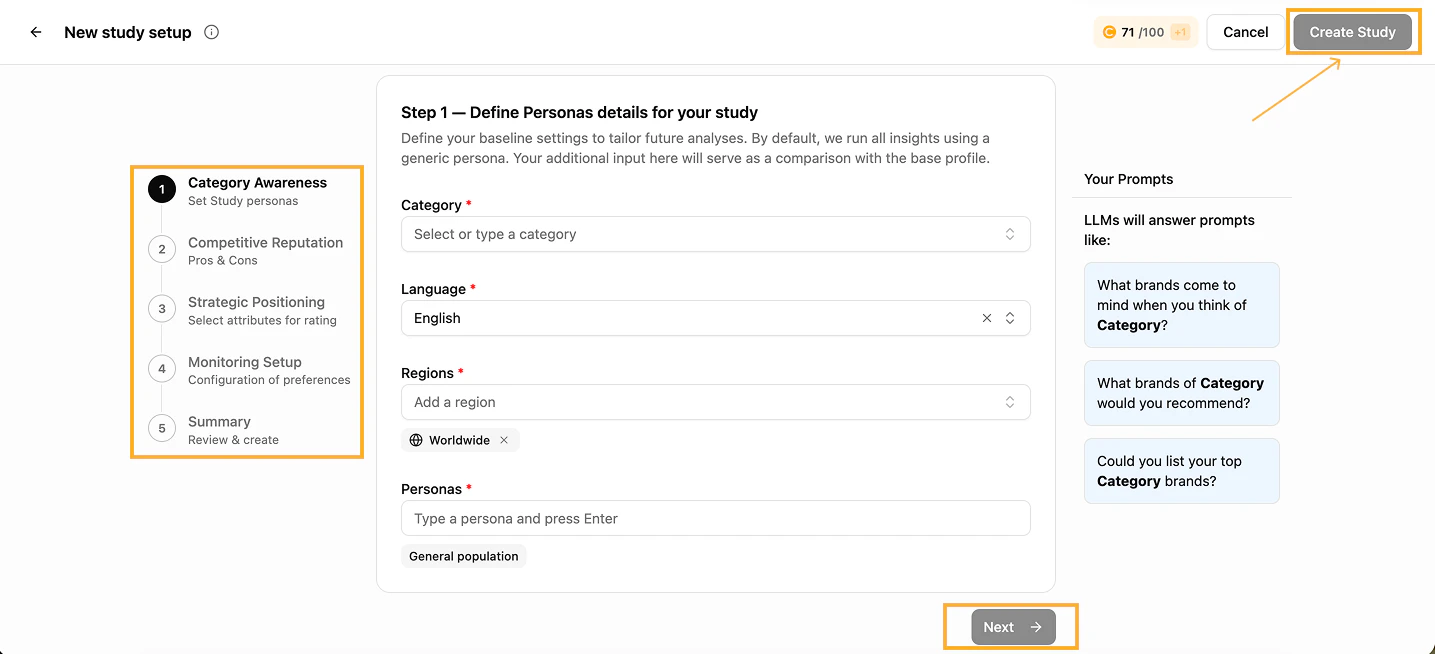
Create a new analysis

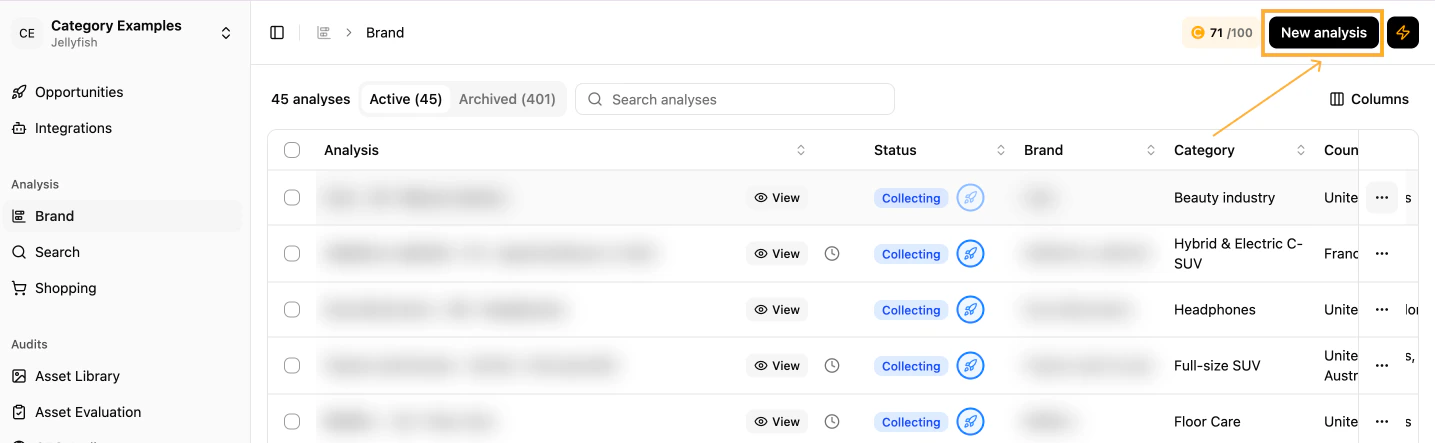
Click Create New Analysis to open the configuration form.
Create new analysis
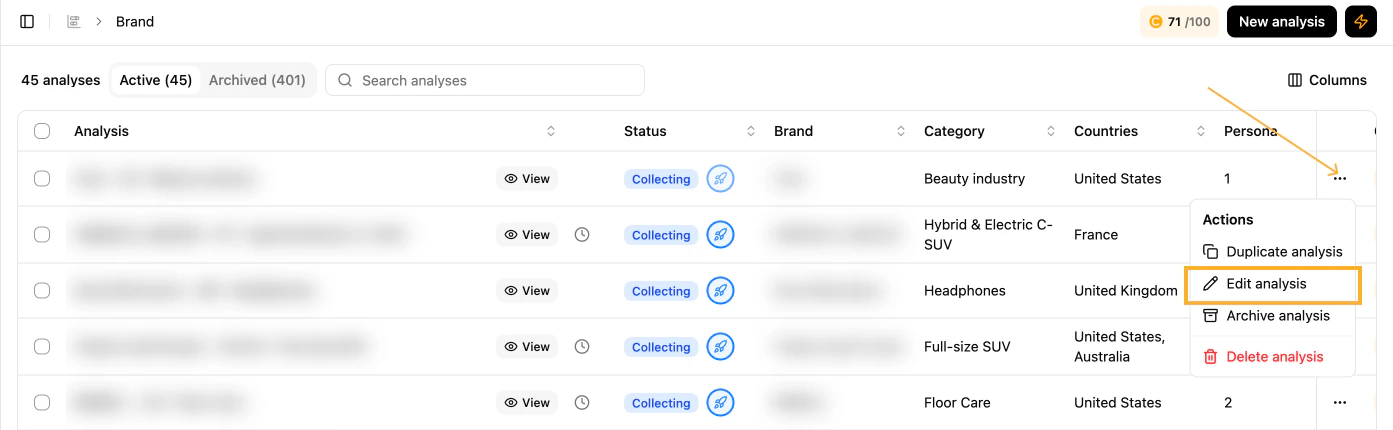
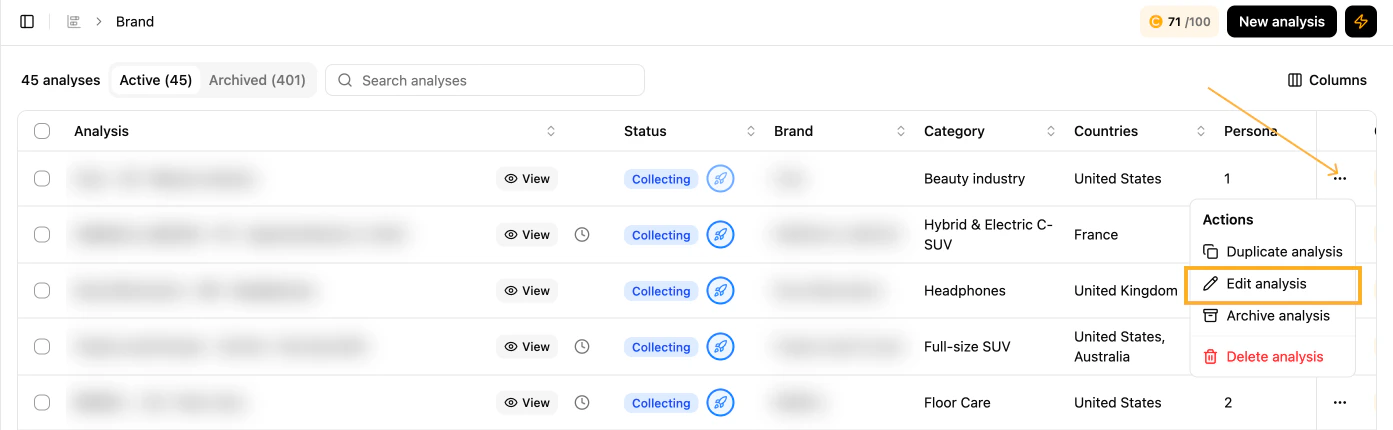
You can rename any analysis post-launch from Edit Analysis.
Edit analysis name
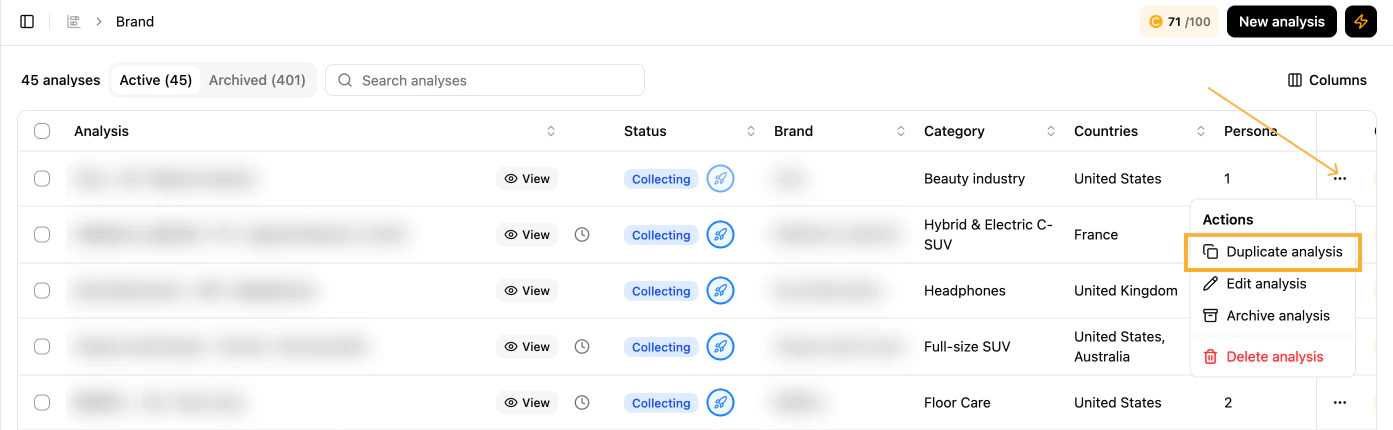
To replicate an existing analysis, use Duplicate analysis.
Duplicate analysis

Analysis status

The progress of an analysis is tracked through three statuses:
  • Launching — initial 15–20 minutes after creation.
  • Collecting — data is gathered over the next 2–3 weeks. Trends may shift as more data arrives.
  • Live — data has stabilised and is ready for insights.

Analysis timer

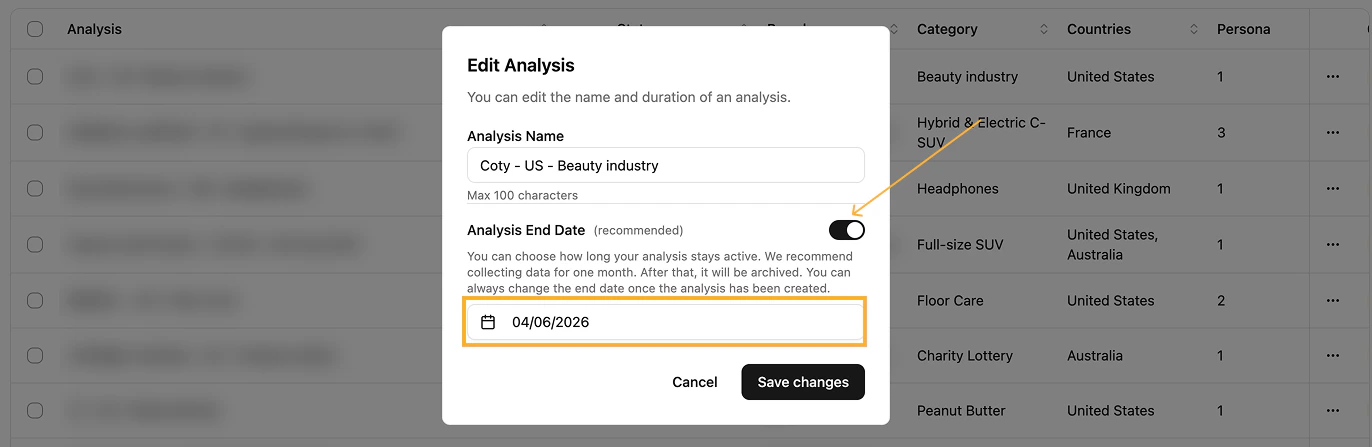
The end date marks when data collection stops. The analysis is then automatically paused until manually unarchived; no data is backfilled for the paused period. The timer can be edited from Edit Analysis alongside the analysis name.
Edit name
Edit end date

Create a new analysis — best practices

1

Enter the brand name

Make sure the brand name is spelled correctly.
2

Select the language

Match the language to the analysis region. For example, pick German for an analysis in Germany.
3

Pick a category

Choose a category relevant to the brand and region. Watch for spelling errors.
4

Set the analysis end date

We recommend collecting data for at least one month, after which the analysis is archived. You can change or remove the end date later.
5

Choose 3 competitors

Three competitors relevant to the brand and region must be defined for comparison. Spelling matters.
6

Select 6 attributes

Six attributes are required to launch the analysis — they drive perception scoring on specific dimensions.
7

Pick the LLM models

Enrich your analysis by selecting the AI models to include. OpenAI, Google AI, Meta AI and Anthropic are pre-selected by default for optimal coverage.
8

Select regions (optional)

Pick up to 8 regions per analysis from the dropdown.
9

Define personas (optional)

Define up to 5 personas per analysis based on interests, demographics and location. Example: A 35-year-old woman who lives in the city.
You can use AI-suggested options on the UI for every input above.
10

Create the analysis

Once all parameters are entered and verified, click Create Analysis to start data collection.
Create analysis
Data is available after a 15-minute delay. The View Details button stays inactive until then. Refresh after 15–20 minutes to access the dashboards.

Insights available after launch

  • AI brand awareness — Category Landscape
  • AI category & brand perception — Category perception and Brand Perception (based on custom attributes)
  • Sources (beta) — most influential sources AI models reference for your category
  • Smart Audiences (beta) — most relevant customer personas per category, based on advanced LLM understanding
You can review the configuration of any analysis via the Show Configuration toggle in the top-right corner. Filters are available for time period, individual LLMs, regions (when more than one) and personas (when more than one).
Wait at least 2–3 weeks of data collection to obtain stabilised data ready for insights.

What’s next

Prompt System & Methodology

Understand how the Brand module works.

Category Landscape

Read awareness charts for your category.

Pros & Cons

Read perception charts for your category.

FAQs

Quick answers on metrics and methodology.