> ## Documentation Index
> Fetch the complete documentation index at: https://docs.shareofmodel.ai/llms.txt
> Use this file to discover all available pages before exploring further.
# What's the difference between sources and links?
> Cited URLs feed the LLM's answer; ranked URLs appear in it. Learn why the distinction matters for activation.
In the **Search Visibility** module you already see domains and URLs ranked, along with brand mentions. You also see **sources and citations** appear. Both look like URLs or domains — what's the difference, and why does it matter for activation?
## Cited URL vs. Ranked URL
| Term | What it means | Key attributes |
| -------------- | ----------------------------------------------------------------------------------------------- | --------------------------------------------------------------------------------------------------------------------------------------------------------------------------------------------------- |
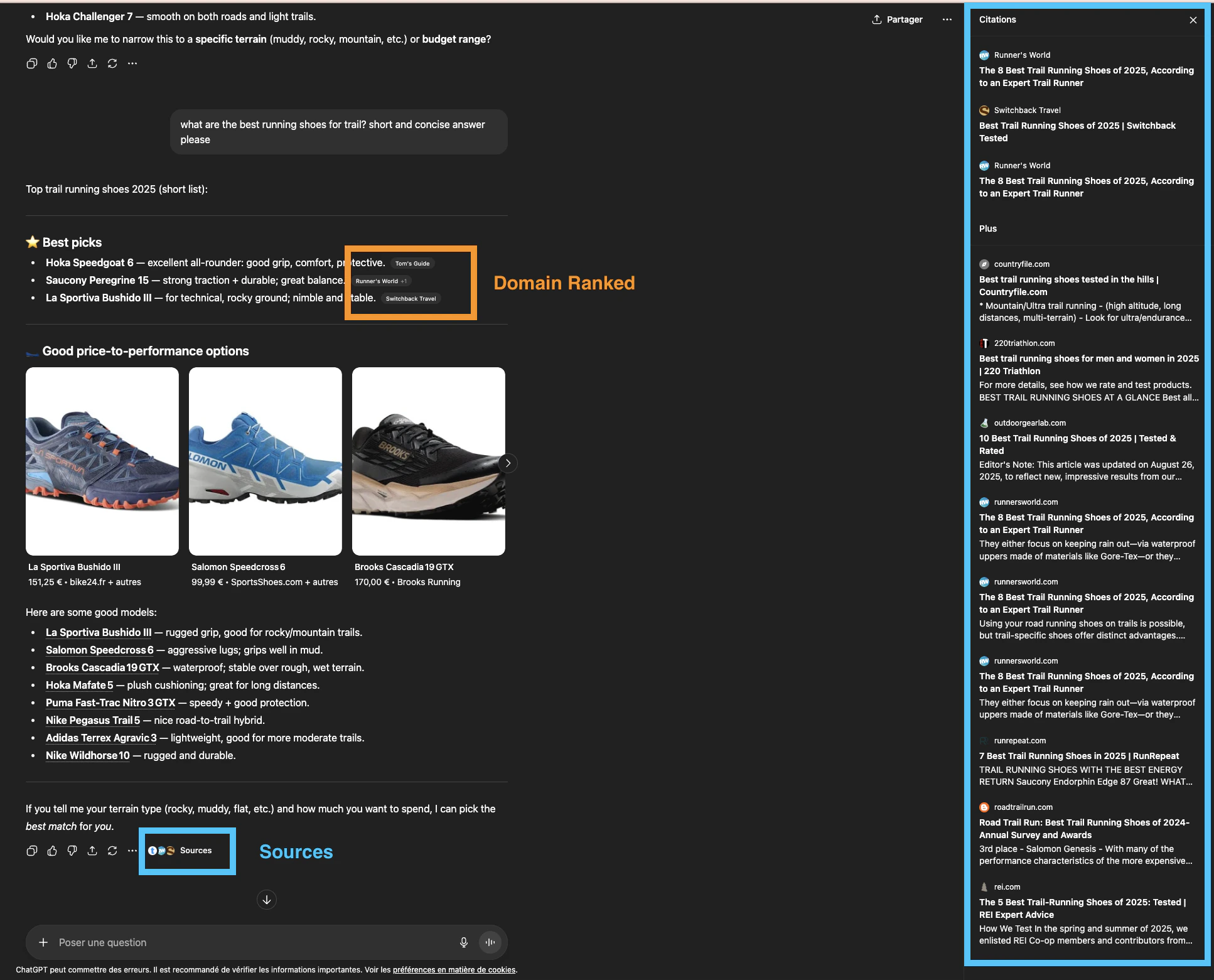
| **Cited URL** | A URL whose content the LLM uses to *generate* its answer. This is a Source. | Has a *citation rate* (frequency as a source). No ranking position. LLMs only. Labelled "Source" in Share Of Model (Search module). |
| **Ranked URL** | A URL that *appears directly* in the model's generated answer (shown as a link or visible URL). | Has a *presence rate* (frequency of visibility). Has a *rank* or *position* in the answer. Concerns LLMs and traditional engines (Google, Bing). Labelled "Link" in Share Of Model (Search module). |
## Examples
Prompt: *"What are the best running shoes for trail?"*
In ChatGPT you may see the answer cite several **sources** behind the scenes — URLs whose content was used to build the answer — alongside some **ranked domains as links**.
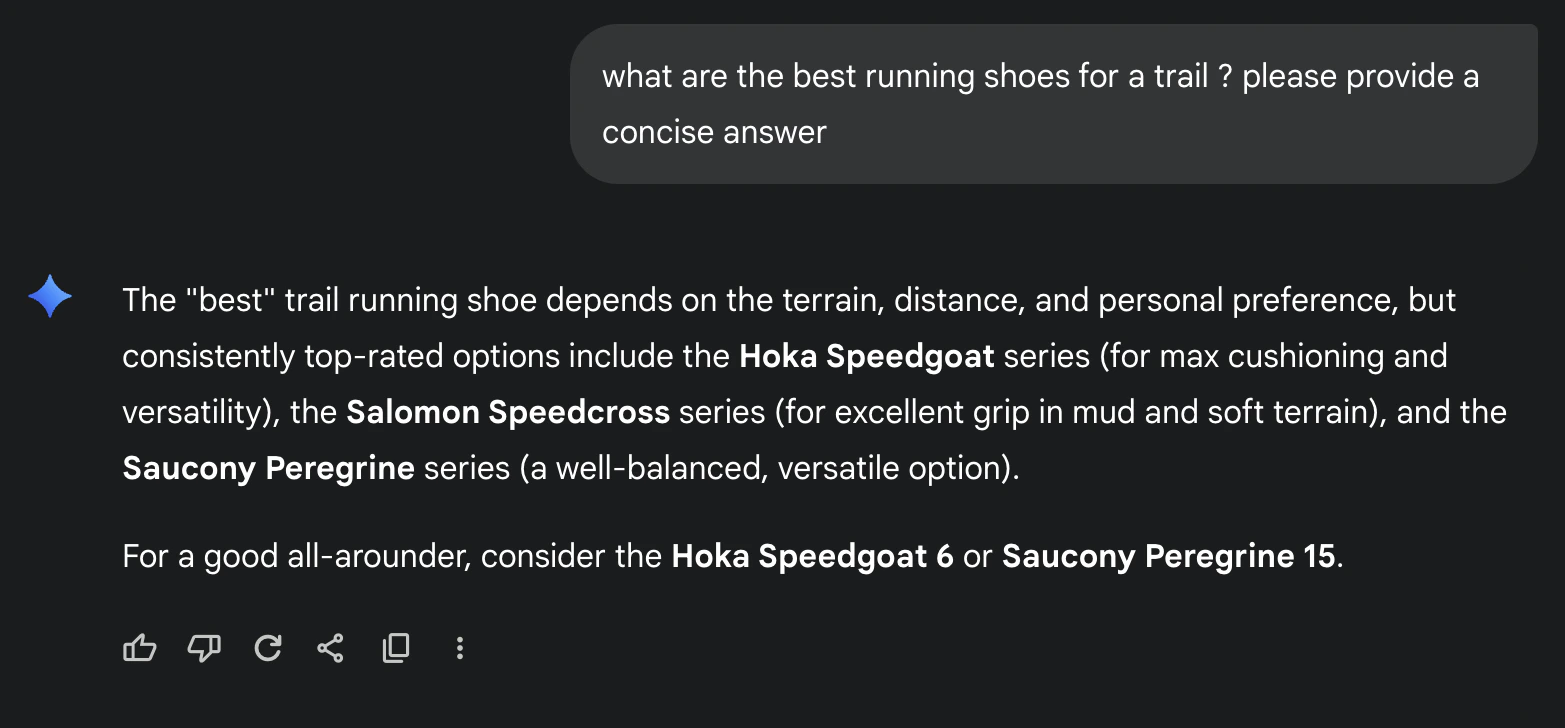
 Sources are not always accessible from the user interface. In Gemini, for the same prompt, neither the sources nor any ranked domain appears in the visible answer.
 ## Important notes
* The model **always** uses sources (cited URLs) to build its answer.
* Not all sources are displayed as ranked URLs, and not all ranked URLs are used as sources.
* Whether sources are accessible depends on the model, prompt and collect.
* There are typically **more sources** feeding the answer than URLs shown in the final response.
* Sources may or may not mention brands.
## Why we distinguish the two
The distinction matters for **activation and strategy** — each type plays a different role in your visibility ecosystem.
| Objective | Focus on | Why it matters |
| --------------------------------------- | -------------------- | --------------------------------------------------------------------------------------------------------------------------------------- |
| **Content influence / brand authority** | Cited URLs (Sources) | Indicates which domains the LLM trusts to generate answers. Being cited as a source strengthens brand authority in AI-generated search. |
| **Visibility / click potential** | Ranked URLs (Links) | These appear in front of users and can drive clicks or impressions. Comparable to SEO rankings inside LLM answers. |
## To recap
* **Cited URLs** = "Sources" in the Search module = what the LLM *reads*.
* **Ranked URLs** = "Links" in the Search module = what the user *sees*.
* Both matter — they activate different levers: **influence vs. visibility**.
## What's next
Explore sources and links in the platform.
The internal layer that produces sources and links.
## Important notes
* The model **always** uses sources (cited URLs) to build its answer.
* Not all sources are displayed as ranked URLs, and not all ranked URLs are used as sources.
* Whether sources are accessible depends on the model, prompt and collect.
* There are typically **more sources** feeding the answer than URLs shown in the final response.
* Sources may or may not mention brands.
## Why we distinguish the two
The distinction matters for **activation and strategy** — each type plays a different role in your visibility ecosystem.
| Objective | Focus on | Why it matters |
| --------------------------------------- | -------------------- | --------------------------------------------------------------------------------------------------------------------------------------- |
| **Content influence / brand authority** | Cited URLs (Sources) | Indicates which domains the LLM trusts to generate answers. Being cited as a source strengthens brand authority in AI-generated search. |
| **Visibility / click potential** | Ranked URLs (Links) | These appear in front of users and can drive clicks or impressions. Comparable to SEO rankings inside LLM answers. |
## To recap
* **Cited URLs** = "Sources" in the Search module = what the LLM *reads*.
* **Ranked URLs** = "Links" in the Search module = what the user *sees*.
* Both matter — they activate different levers: **influence vs. visibility**.
## What's next
Explore sources and links in the platform.
The internal layer that produces sources and links.