> ## Documentation Index
> Fetch the complete documentation index at: https://docs.shareofmodel.ai/llms.txt
> Use this file to discover all available pages before exploring further.
# Sources & Links
> Understand how domains and URLs influence LLM answers and how they appear in the final output.
In generative search, the final answer is only part of the story. LLMs rely on two distinct layers:
* **Sources** — domains and URLs used to build the answer (influence)
* **Links** — domains and URLs shown in the final output (visibility)
These two layers often differ. Together they shape **what is visible** and **how brands are represented** in generative answers.
The **Sources & Links** view helps you see which domains influence answers, which ones reach users, and how brand mentions are framed across engines.
Read [The difference between Sources and Links in LLM Search](/platform/search/what-s-the-difference-between-sources-and-links) for a deeper primer.
## What this view helps you analyse
### Main table: domains and URLs at a glance
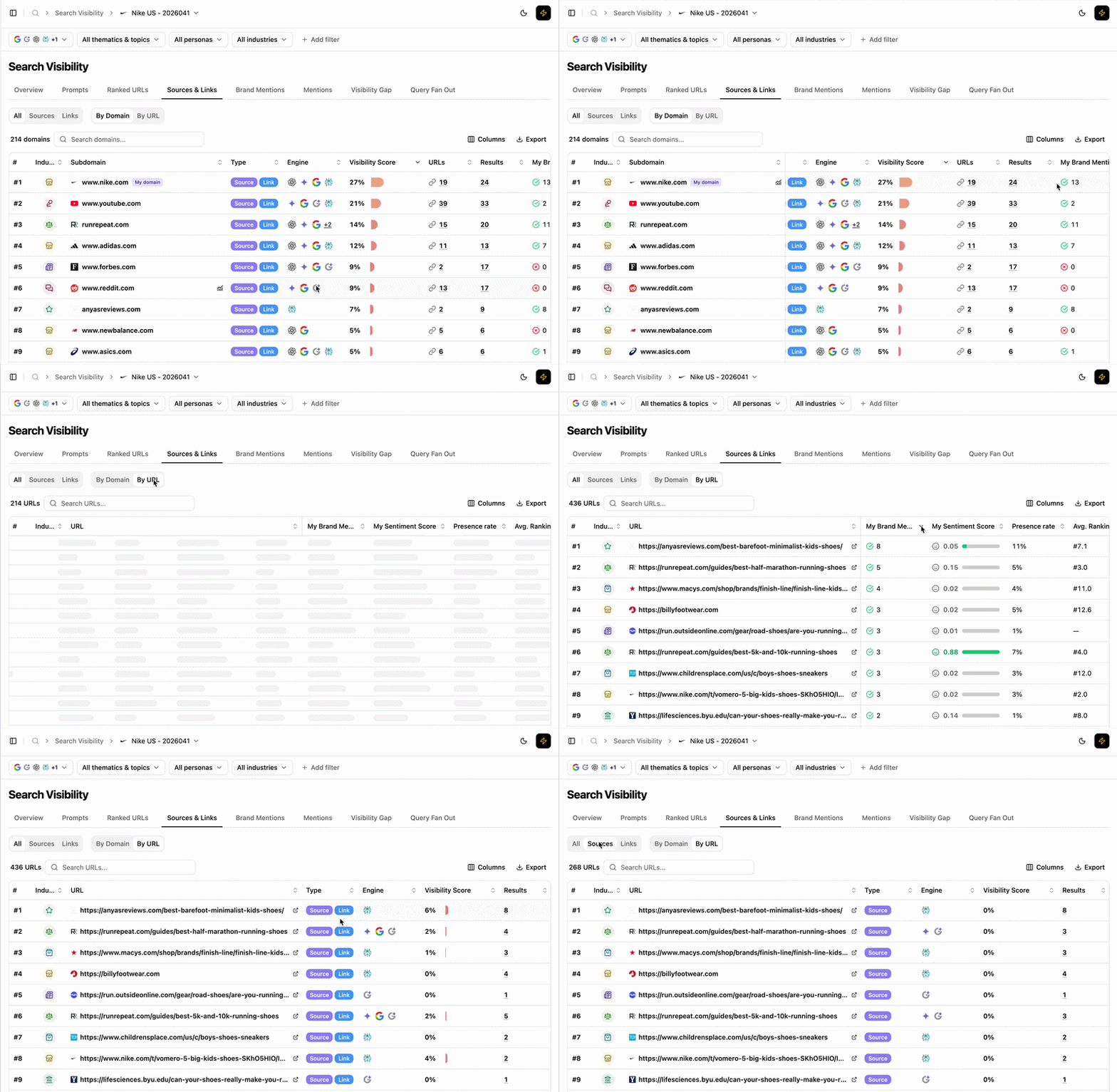 Compare domains and URLs across three dimensions.
#### Role in the answer
The **Type** column shows whether a domain is:
* **Source** — used to build the answer
* **Link** — visible in the final output
* **Source & Link** — both influencing and visible
#### Consistency across engines and queries
Use the **Engines**, **Results** and **Presence rate** columns to distinguish one-off appearances from recurring influence.
#### Brand mentions & sentiment
The **My Brand Mentions** column flags whether your brand is mentioned in the source content or generated answer (returned by the LLM API).
Mentions embedded directly inside URL strings are not counted.
When a brand is mentioned, **sentiment** scores qualify how it is framed (range from `-1` to `+1`, with a breakdown of positive, neutral and negative mentions).
### Domain details: content patterns
Compare domains and URLs across three dimensions.
#### Role in the answer
The **Type** column shows whether a domain is:
* **Source** — used to build the answer
* **Link** — visible in the final output
* **Source & Link** — both influencing and visible
#### Consistency across engines and queries
Use the **Engines**, **Results** and **Presence rate** columns to distinguish one-off appearances from recurring influence.
#### Brand mentions & sentiment
The **My Brand Mentions** column flags whether your brand is mentioned in the source content or generated answer (returned by the LLM API).
Mentions embedded directly inside URL strings are not counted.
When a brand is mentioned, **sentiment** scores qualify how it is framed (range from `-1` to `+1`, with a breakdown of positive, neutral and negative mentions).
### Domain details: content patterns
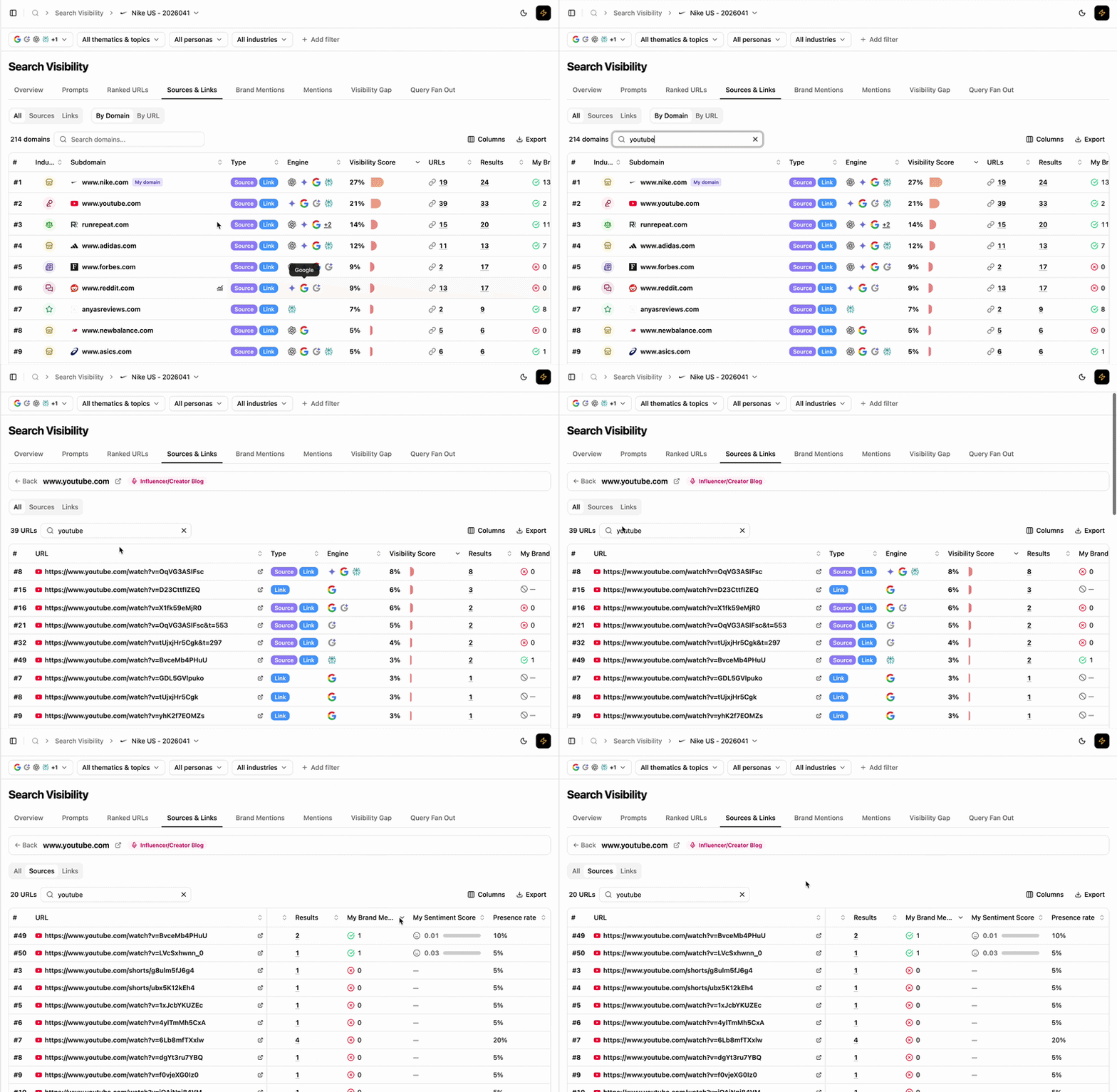 Click a domain to see the URLs associated with that source. You can observe:
* which URLs are used as Sources, Links, or both,
* how often each URL appears,
* whether brand mentions are present at URL level,
* how brand sentiment varies across URLs from the same domain,
* the underlying content (open URLs directly from the interface).
### Results details: linking domains, URLs and queries
Click a domain to see the URLs associated with that source. You can observe:
* which URLs are used as Sources, Links, or both,
* how often each URL appears,
* whether brand mentions are present at URL level,
* how brand sentiment varies across URLs from the same domain,
* the underlying content (open URLs directly from the interface).
### Results details: linking domains, URLs and queries
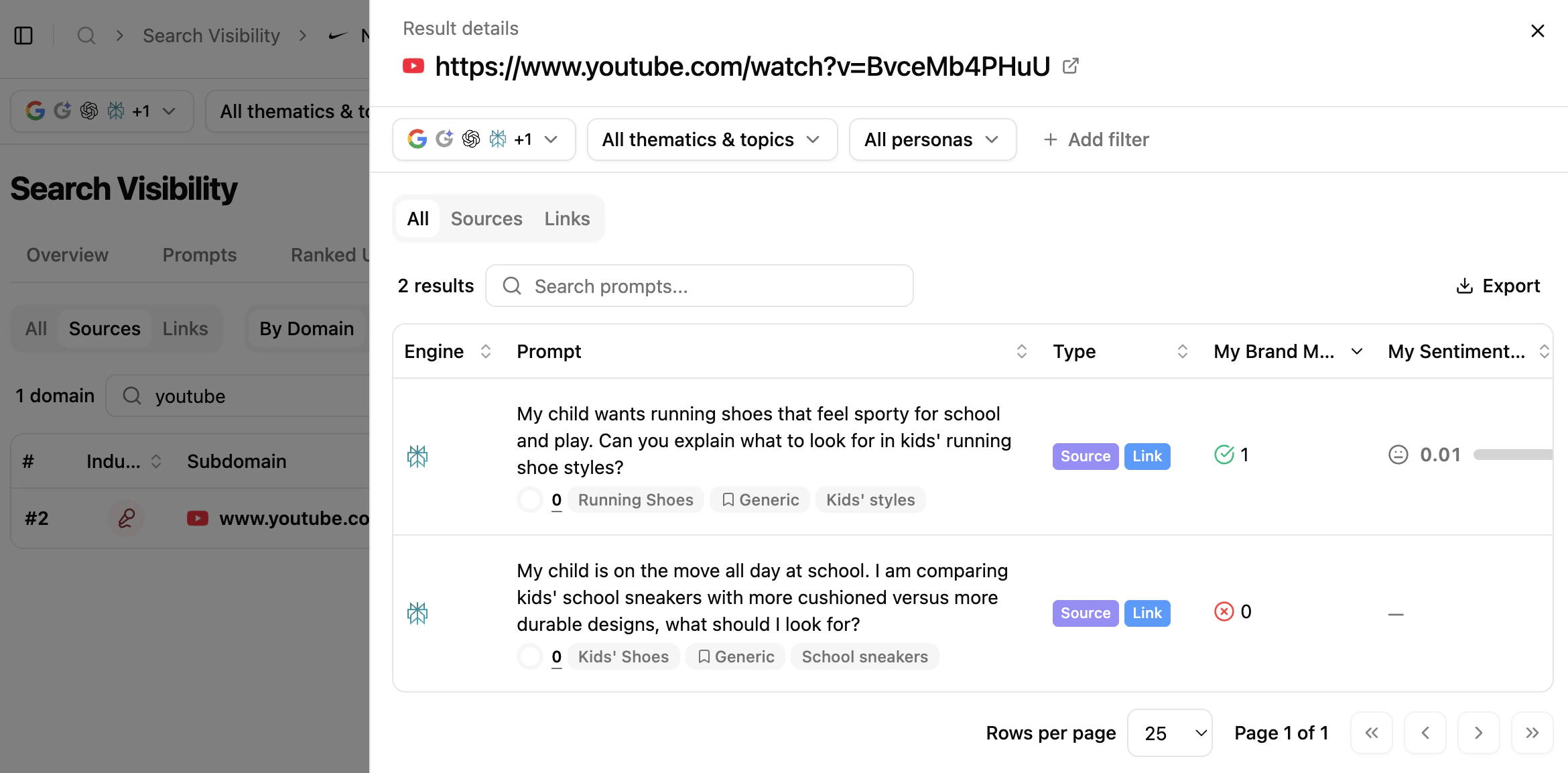 Clicking the **Results** number opens the queries by engine on which the item appears as a Source and/or Link.
You may notice that:
* the same query behaves differently across engines,
* a domain is a Source on one engine and a Link on another,
* some queries rely on Sources without showing Links,
* the same domain can mention a brand with different sentiment depending on the query or engine.
## Reading cues
These are signals to read, not rules.
Content that is both trusted by the model to build its response and structured to be easily surfaced in the final output. Common on queries that require synthesis or both explanation and examples.
Content that explains concepts, provides background or supports the model's reasoning. Common on queries where understanding the topic matters more than pointing to a single reference.
Content that is easy to reference and clearly structured (lists, steps, summaries). Common when the model benefits from pointing users to concrete resources.
Reflects different source-selection logic and engine preferences for structure, depth or citation. LLM visibility should be read engine by engine, not as a single aggregated signal.
LLMs adapt how they use content based on the nature of the question, rather than applying a fixed rule.
## How to use this view effectively
Start by identifying domains that consistently act as **Sources**, even when they are not visible as **Links**. These shape how answers are constructed and reveal where influence happens before visibility.
## What's next
Conceptual primer on the two layers.
Drill into URL-level visibility.
Clicking the **Results** number opens the queries by engine on which the item appears as a Source and/or Link.
You may notice that:
* the same query behaves differently across engines,
* a domain is a Source on one engine and a Link on another,
* some queries rely on Sources without showing Links,
* the same domain can mention a brand with different sentiment depending on the query or engine.
## Reading cues
These are signals to read, not rules.
Content that is both trusted by the model to build its response and structured to be easily surfaced in the final output. Common on queries that require synthesis or both explanation and examples.
Content that explains concepts, provides background or supports the model's reasoning. Common on queries where understanding the topic matters more than pointing to a single reference.
Content that is easy to reference and clearly structured (lists, steps, summaries). Common when the model benefits from pointing users to concrete resources.
Reflects different source-selection logic and engine preferences for structure, depth or citation. LLM visibility should be read engine by engine, not as a single aggregated signal.
LLMs adapt how they use content based on the nature of the question, rather than applying a fixed rule.
## How to use this view effectively
Start by identifying domains that consistently act as **Sources**, even when they are not visible as **Links**. These shape how answers are constructed and reveal where influence happens before visibility.
## What's next
Conceptual primer on the two layers.
Drill into URL-level visibility.