> ## Documentation Index
> Fetch the complete documentation index at: https://docs.shareofmodel.ai/llms.txt
> Use this file to discover all available pages before exploring further.
# Attribute Influence Sources (Beta)
> Identify the websites and platforms that most influence LLM understanding of your category.
This view enables a lightweight exploration based on a set of generated prompts that cover all key attributes per analysis and common user intentions. Each prompt simulates a real user query — without mentioning any brands — and is sent to LLMs to identify the online sources they draw on when forming answers.
By aggregating these sources, the page reveals the **most influential websites and platforms** contributing to how LLMs understand your category landscape.
## How prompts are generated
To ensure diversity and realistic context, prompts are generated across three user-intention types:
| Intent type | What it captures |
| ---------------------------- | ----------------------------------------------------------------------------- |
| **Information request** | Educational or factual prompts emphasising expert, authoritative sources. |
| **Media & social retrieval** | Prompts based on news, opinion and social media — capturing public discourse. |
| **Product purchase** | Queries reflecting buying intent, surfacing retail and commercial sources. |
This range covers the full spectrum of user behaviour, from informational and social to transactional.
## How the Influence Score works
Each source receives an **Influence Score** based on how frequently it appears and how prominently it is positioned across AI-generated responses. The formula combines two dimensions:
* **Frequency (75%)** — how often a domain appears in responses.
* **Position (25%)** — how high that domain ranks in the list.
The weighting ensures repetition — the most consistent signal of visibility — matters most, while still rewarding sources that appear early in the response.
### Why position matters more at the top
People look more at the top of any list, so the formula uses a curve that gives extra credit to websites in the first few positions — similar to how Google search treats the top of a SERP.
### Why this works well
* **More frequent** = more visible and likely more trusted.
* **Higher position** = more attention from users.
* **Combined**, both produce a strong picture of which websites users are most likely to see and trust in AI results.
## Score interpretation
| Score range | Reading |
| ------------ | -------------------------------------------------------------- |
| **50–100** | Domain is frequently cited and appears in prominent positions. |
| **20–50** | Moderate citation frequency and/or positioning. |
| **Below 20** | Limited presence or appears in less visible positions. |
The scoring system reflects real user behaviour — sources mentioned first carry significantly more weight than those listed later.
## Interface components
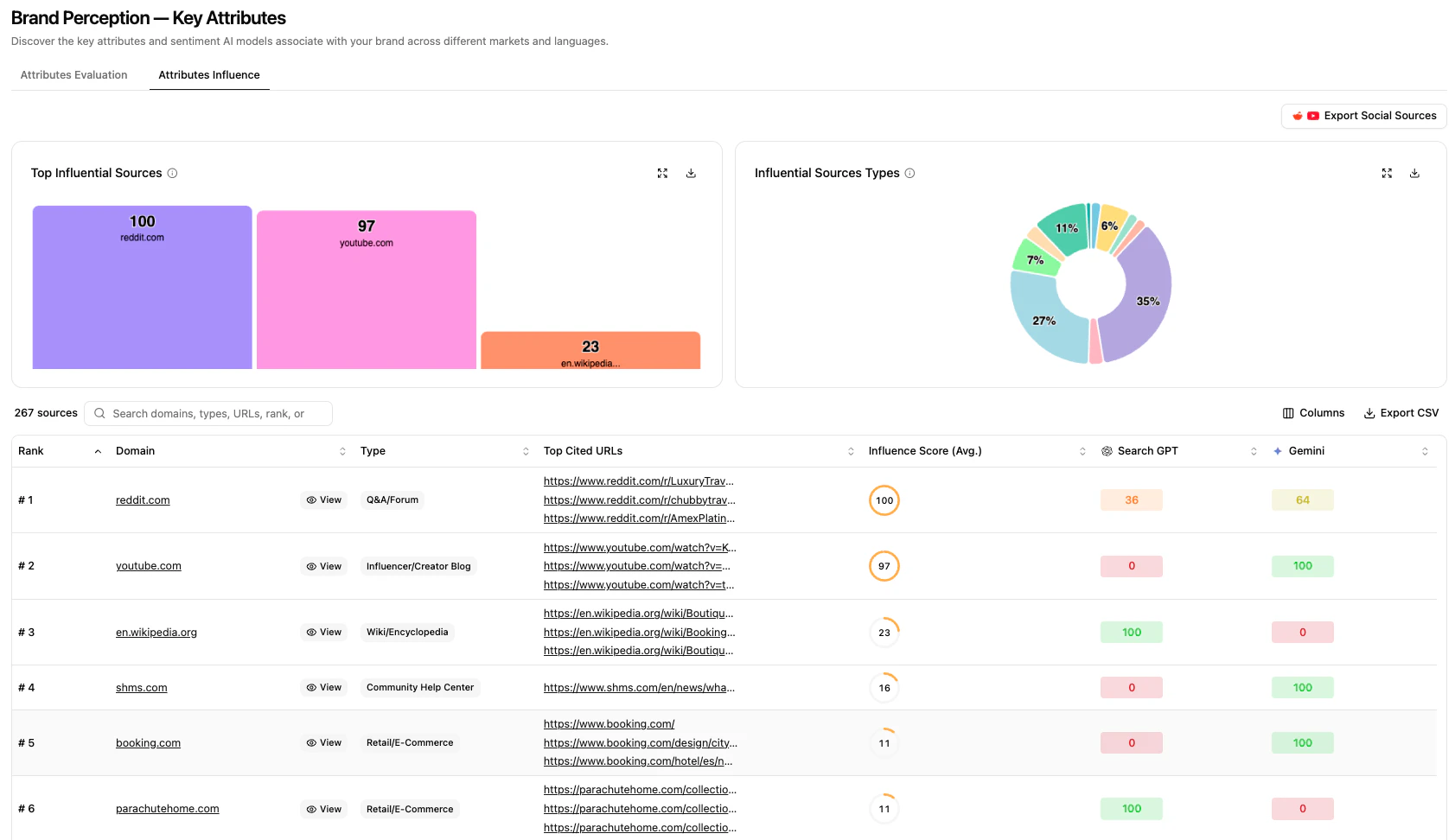
Bar chart of the three most influential domains and their scores — immediate insight into market leaders.
Pie-chart breakdown of source types (Specialist Blogs, News Media, Retail/Commerce, etc.) — understand the media landscape for your category.
Trend visualisation showing how source influence evolves — track shifting AI preferences and emerging influential domains.
## Detailed source table
| Column | Description |
| ---------------------- | --------------------------------------------------------------------------------------------- |
| **Rank** | Position in the influence hierarchy. |
| **Domain** | Source website. |
| **Type** | Category classification (News Media, Specialist Blog, Branded site, Retail/E-commerce, etc.). |
| **Top Cited URLs** | Most frequently referenced pages. |
| **Influence Score** | Average visibility metric. |
| **SearchGPT & Gemini** | Platform-specific performance indicators. |
 In the **Sources** module, the analysis is **not centered on brand mentions**. The brand and competitor analysis parameters are not used in this section. Data collection prompts rely only on:
* the analysis category,
* the analysis attributes,
* the countries.
Sources highlights influential domains and URLs based purely on categories and attributes, without referencing any specific brand names.
## What's next
Inspect Reddit conversations behind the scores.
See sources and links inside the Search module.
In the **Sources** module, the analysis is **not centered on brand mentions**. The brand and competitor analysis parameters are not used in this section. Data collection prompts rely only on:
* the analysis category,
* the analysis attributes,
* the countries.
Sources highlights influential domains and URLs based purely on categories and attributes, without referencing any specific brand names.
## What's next
Inspect Reddit conversations behind the scores.
See sources and links inside the Search module.